
Worn Brake Pads Failed Roadworthy - Mercedes in Burbank
I inspected a Mercedes 450 SEC in Burbank this week. The owner mentioned he’d been hearing a strange noise when braking. When I checked the rear brakes, the reason was obvious.
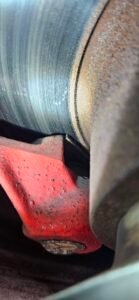
The rear left brake pads were completely worn down. The friction material was gone entirely – just metal remaining. This means it was grinding metal on metal against the brake disc every time the driver hit the brakes. You can see in the photo how there’s no friction surface left at all.
What made this worse was that the rear right side still had plenty of pad material left. That kind of uneven wear between left and right on the same axle is a red flag. It usually means one of two things.
The most likely cause is a seized or sticking brake caliper on the opposite side. If the rear right caliper isn’t applying properly, the rear left ends up doing all the work and wears out much faster. That means the car has been braking unevenly – pulling to one side under heavy braking – which is a serious safety issue.
The less likely cause is poor quality brake pads that wear unevenly, but with a difference this extreme that’s unlikely to be the explanation.

Why this is dangerous
Driving with metal-on-metal brakes is not just a roadworthy fail – it’s genuinely dangerous. Here’s what can happen:
Reduced braking power is the obvious one. With no friction material, the brake can’t grip the disc properly. Your stopping distance increases significantly.
Heat buildup from metal grinding on metal can cause the brake disc to overheat. In extreme cases this can warp the disc, crack it, or cause the brake to seize completely – meaning the wheel locks up while driving.
Uneven braking means the car doesn’t slow down in a straight line. Under emergency braking this can cause the car to pull sharply to one side, potentially into oncoming traffic or off the road.
Brake fluid can boil if the caliper overheats from the friction, leading to complete brake failure where the pedal goes to the floor and nothing happens.
If you hear a noise when braking – don’t ignore it
Squealing, grinding, or scraping sounds when you brake are your car telling you something is wrong. A high-pitched squeal often means the pads are getting low – most brake pads have a built-in wear indicator that makes this sound as a warning. A grinding or scraping noise usually means the pads are already gone and it’s metal on metal.
Don’t take this lightly. Get it checked by a mechanic before it gets worse – and definitely before booking a roadworthy inspection. Worn brakes are a guaranteed fail, and more importantly, they put you and everyone else on the road at risk.