
Does My Boat Trailer Need a Roadworthy in Queensland?
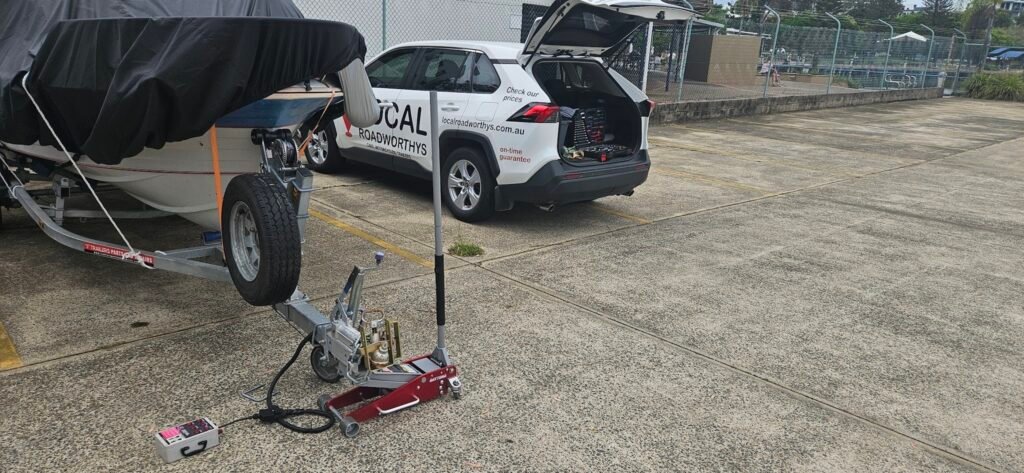
I inspected this boat trailer in Wellington Point today. The owner wasn’t sure whether his trailer actually needed a roadworthy or not. It’s a common question from boat owners, so here’s the full answer.
Only if the ATM is over 750kg
Your boat trailer needs a roadworthy certificate if its ATM (Aggregate Trailer Mass) is 751kg or more. If the ATM is 750kg or less, no roadworthy is required.
The boat itself does not need a roadworthy. Only the trailer. When you’re selling a boat and trailer package, the buyer needs a roadworthy for the trailer but not for the boat.
Simple rule – trailer over 750kg ATM = roadworthy required. Trailer 750kg or under = no roadworthy needed.
How to find out your trailer's ATM
This is where it gets tricky, and where a lot of people get confused. There are only two reliable ways to check the ATM of your trailer:
1. The compliance plate. This is a metal plate attached to the trailer, usually on the drawbar at the front. It shows the ATM, manufacturer, date of manufacture, and VIN. On this boat trailer in Wellington Point, the compliance plate was hidden behind the jockey wheel. I had to remove the jockey wheel to see it. That’s unusual but it happens – compliance plates aren’t always easy to find. Check the drawbar, the tongue, and around the coupling area.
2. The official registration certificate. This is the certificate you received when the trailer was first registered. It clearly shows the ATM. You can request a copy online at the Queensland TMR website if you don’t have the original.
What does NOT show the ATM
This is important. People regularly call me saying “my trailer is under 750kg, I checked online” – and then it turns out to be over 750kg when I look at the compliance plate. Here’s why this happens:
A registration renewal notice is not a registration certificate. The renewal notice you get in the mail when your rego is due does not show the actual ATM. It sometimes says something like “ATM up to 1.05t.” Read that carefully – “up to” 1.05t could mean anything from 750kg or less up to 1,050kg. It doesn’t tell you the actual number. You cannot rely on this to determine whether you need a roadworthy.
A rego check is not a registration certificate. Checking your registration status online does not show the actual ATM either.
A PPSR certificate is not a registration certificate. A PPSR (Personal Property Securities Register) check is useful for checking finance and stolen vehicle history, but it does not show the ATM.
The only two documents that show the actual ATM are the compliance plate on the trailer itself and the official registration certificate from TMR.
If you’re unsure, request a registration certificate online or send me a photo of the compliance plate and I’ll tell you whether your trailer needs a roadworthy.
Common boat trailer issues
Boat trailers have their own set of problems that I see regularly, mostly caused by saltwater exposure:
Corroded brakes. This is the number one boat trailer issue. Saltwater destroys brake rotors and pads over time. If you regularly launch your trailer in saltwater, the brakes will corrode. Heavily corroded brakes fail the inspection.
Corroded compliance plates. Saltwater also attacks the compliance plate. If the plate is unreadable due to corrosion, that’s a problem. The plate needs to be legible. This is another reason to have your registration certificate as a backup.
Cracked or perished tyres. Boat trailers often sit unused for weeks or months between trips. The tyres deteriorate from age and UV exposure even if the tread looks fine. Cracked sidewalls fail the inspection.
Non-working lights. Trailer lights get submerged during boat launching and the wiring corrodes over time. Test all your lights by connecting the trailer to a vehicle before the inspection.
Seized wheel bearings. Saltwater gets into the bearings and causes corrosion and seizing. Wheel bearings with excessive play or roughness fail.
HVRAS measurement
If your trailer requires a HVRAS measurement, as of July 2026 you can do this yourself – you no longer need to pay someone to do it for you. For registration, all you need from me is the safety certificate. Any other forms can be filled out by the owner.
Tips before booking
Connect the trailer to a vehicle and test all the lights. This is the most common fail point and the easiest to check.
Check the compliance plate. Make sure you can find it and that it’s readable. If you can’t find it, check under the jockey wheel, around the coupling, and along the drawbar.
If the trailer has brakes, check that they’re not seized. Try to spin the wheels by hand – they should turn freely when the brakes aren’t applied.
Look at the tyres. If they’re cracked, flat, or bald, replace them before the inspection.
Also worth reading: do camper trailers need a roadworthy and motorhome roadworthy rules in Queensland. I am licensed to inspect trailers – see the trailer roadworthy page and prices.