Is a Test Drive Part of a Roadworthy Inspection?
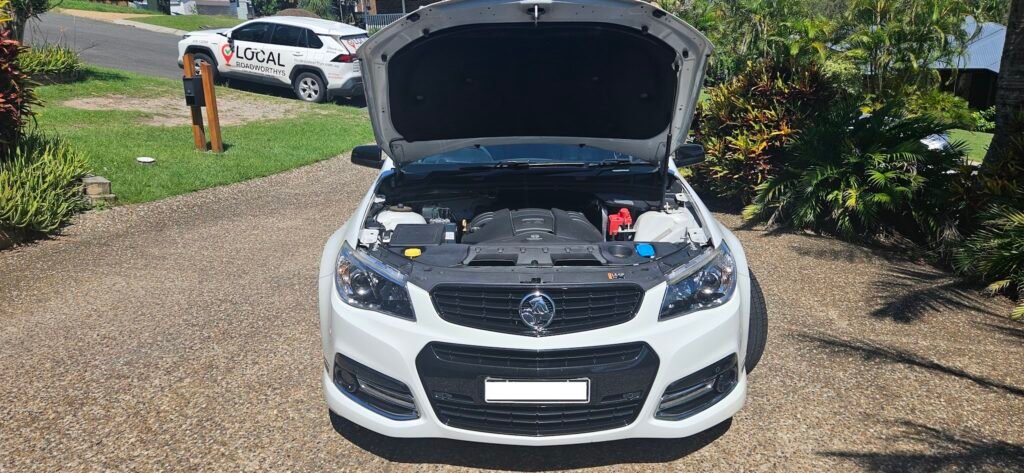
I inspected this Holden Commodore SSV in Mount Warren Park today. Clean car, well looked after, passed without any problems. But the test drive question comes up constantly, so here’s everything you need to know.
Yes, a test drive is mandatory for every roadworthy inspection in Queensland. It cannot be skipped.
Worried about someone else driving your car?
I understand this concern, especially with performance cars, expensive cars, or cars that owners are emotionally attached to. Handing the key to someone and watching them drive off isn’t easy.
You’re welcome to sit next to me during the test drive. Many owners of performance or high-value cars choose to do this and that’s perfectly fine. It doesn’t affect the inspection in any way.
I drive all sorts of cars every day. Multiple test drives, every day, in everything from 20-year-old Corollas to brand new European cars. A 1km test drive in your car is part of my daily routine. I treat every vehicle with respect and I’m not there to enjoy a joyride.
Local Roadworthys carries proper business insurance that explicitly covers test driving customer vehicles. The vehicle is covered during the entire inspection process. This is worth asking about if you’re comparing inspectors – not every operator, especially those advertising on Facebook or Gumtree, carries proper business insurance. If an uninsured inspector damages your car on a test drive, you’re stuck chasing them for compensation. Make sure whoever inspects your vehicle is properly insured before handing over the keys.
How far do I drive?
I keep the test drive to a minimum. If nothing unusual comes up, the drive is about 1km or less – just enough to check everything on the list and complete the recorded brake test. I don’t drive fast and I don’t drive further than necessary.
If I notice something during the drive that needs investigating – an unusual noise, a vibration, a steering issue – the drive may be slightly longer so I can assess it properly. But in most cases it’s a quick loop around the block and back.
Your vehicle must start and be driveable
Before anything else – the vehicle must start. If your car doesn’t start, the inspection cannot happen. I charge a call-out fee and leave. Make sure the battery is charged, the engine runs, and the vehicle is driveable before booking your inspection.
The vehicle also needs to be parked somewhere accessible. On solid, flat ground where it can be driven onto the road. If your car is bogged in mud, stuck in long grass, or parked somewhere it can’t physically be moved from – I can’t inspect it. I am not a towing service. Getting the vehicle into a driveable position is your responsibility before I arrive.
I’ve had customers expect me to inspect a car that was buried in a muddy backyard with a dead battery and no way to move it. That doesn’t work. The vehicle needs to start, it needs to move, and it needs to be somewhere I can take it for a short drive. If it’s not, I charge the call-out fee and that’s it.
The test drive can't be skipped - even if the car has issues
I am required to record a brake test during the test drive. That brake test is uploaded to the official inspection record along with GPS coordinates. The Queensland Government inspection app does not allow me to complete an inspection record without a brake test. Even if I wanted to skip it, the system won’t let me.
This means if your vehicle has a mechanical problem you’re hoping I won’t notice during the drive – a slipping clutch, a grinding gearbox, a pulling brake – the test drive will reveal it. These issues are checked as part of the inspection. A vehicle that can’t be safely driven on the road can’t pass a roadworthy. There’s no way around the test drive.
If the vehicle is so unsafe that I can’t take it on the road at all – no brakes, severe mechanical failure, visible safety hazards – it fails based on what I can see without driving it. The fail list may be longer once the issues are fixed and a proper test drive can be completed during the re-inspection.
What gets checked during the test drive
The test drive isn’t just about going for a spin. There are specific things I’m assessing:
Brakes – do they feel firm, do they stop the car in a straight line, is there any pulling to one side, any vibration, any noise? The recorded brake test measures actual braking performance.
Steering – does the car track straight, is there any play in the wheel, any wandering, any vibration at speed?
Suspension – any knocking, clunking, or unusual noises over bumps? Does the car feel stable?
Transmission – does it shift smoothly, any hesitation, any slipping, any unusual noises?
Engine – any unusual sounds, misfires, or rough running while driving?
Speedometer – is it working?
ABS – if the car has ABS, does the warning light switch off during driving?
Many problems only show up while driving. A wheel bearing that feels fine when spinning the wheel by hand can make noise at 60km/h. A steering issue that’s impossible to detect in a driveway shows up immediately on the road. Brakes that feel ok when pressing the pedal while parked can pull the car sideways under actual braking.
Related: pre-purchase inspections, selling a car without a roadworthy and what happens if a vehicle fails.