
Leaking Shock Absorber Failed Roadworthy - Mini Cooper S in Tarragindi
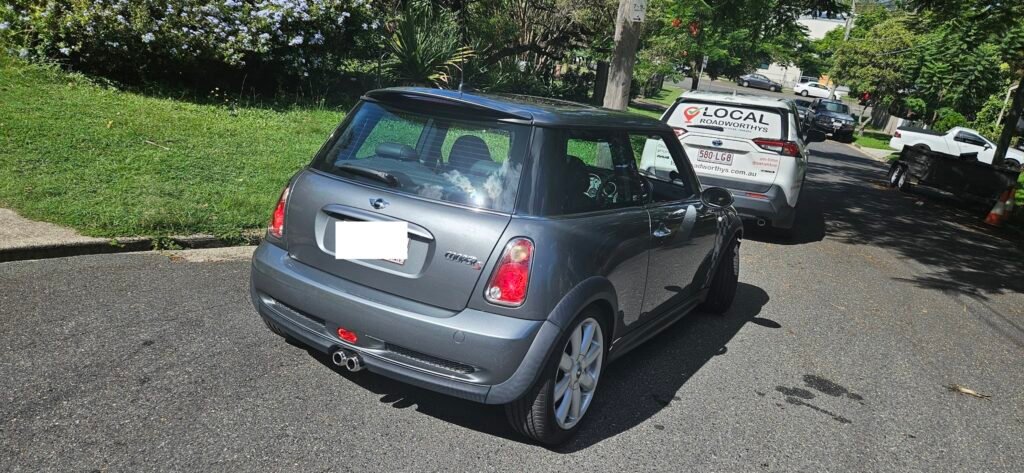
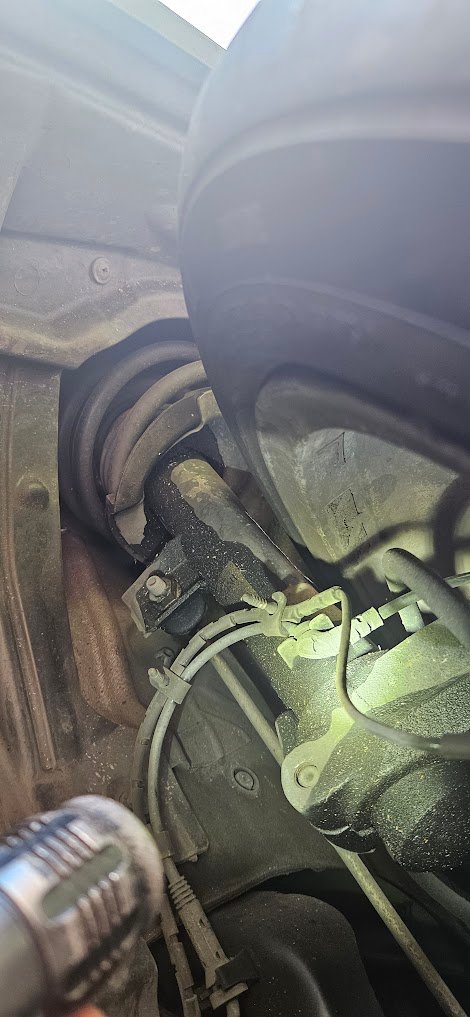
I inspected this Mini Cooper S in Tarragindi today. The owner had clearly taken good care of it – clean, low kilometres, well presented. But it failed for a leaking front shock absorber. You can see the oil residue on the shock body in the close-up photo.
Leaking shocks are a guaranteed fail
A shock absorber that’s leaking oil cannot pass a roadworthy. The oil inside the shock is what provides the damping – it’s what controls how the suspension compresses and rebounds. When the oil leaks out, the shock loses its ability to do its job.
A leaking shock doesn’t fail overnight. It starts as a slight weep, builds to a visible leak, and eventually the shock has so little oil left that it barely functions. By the time I can see oil on the outside of the shock body, there’s already a problem.
Why leaking shocks are dangerous
Shock absorbers keep your tyres in contact with the road. When a shock is working properly, it controls the movement of the suspension so the tyre follows the road surface over bumps, dips, and uneven surfaces. When a shock is leaking and not damping properly, the tyre bounces instead of gripping.
This affects braking distance. A bouncing tyre has less contact with the road, which means less grip, which means it takes longer to stop.
It affects handling. The car feels less stable in corners and at speed. In an emergency swerve, a car with a failed shock can become unpredictable.
It also accelerates tyre wear. A tyre that’s bouncing instead of rolling smoothly wears unevenly and faster than it should.
BMW and Mini - known for leaks
I see leaking shock absorbers on all makes and models, but BMW and Mini (which is part of the BMW group) come up more often than most. It’s not just shocks either. From my experience inspecting thousands of vehicles, BMW and Mini models tend to develop leaks across the board – engine oil leaks from rocker cover gaskets and sensor seals, transmission oil leaks, and leaking shock absorbers.
This Mini in Tarragindi had low kilometres and was well maintained by the owner. Despite that, the shock seal had failed. On some cars, it’s not a matter of neglect – it’s just a characteristic of the brand. Parts that should last longer don’t always last as long as you’d expect.
If you own a BMW or Mini and you’re planning to sell, check your shocks before booking a roadworthy. Look for any oil residue on the shock body or around the base of the shock where it meets the suspension. It’s a common fail point on these cars and catching it early avoids the surprise on inspection day.
How to spot a leaking shock absorber
You can check your shock absorbers yourself without any tools:
Look at each shock absorber through the wheel arch or from underneath the car. The shock is the cylindrical component connected between the suspension and the body of the car. If you see oil or a wet, oily residue on the body of the shock, it’s leaking.
A light film of dust stuck to the shock isn’t necessarily a leak – dust sticks to everything underneath a car. What you’re looking for is a wet, oily surface or visible drips.
If one shock is leaking, check all four. Shocks wear at roughly the same rate, and it’s common for more than one to be leaking at the same time.
You might also notice the symptoms while driving. A car with worn or leaking shocks will feel bouncy over bumps, may nose-dive more than usual under braking, or feel vague and floaty at highway speeds. If you’re noticing any of these, it’s worth checking the shocks before your roadworthy.
Replacing shock absorbers
Shocks are generally replaced in pairs – both fronts or both rears at the same time. Replacing just one side can cause uneven handling because the new shock will perform differently to the worn one on the other side.
The cost varies depending on the car. On a common Japanese or Korean car, shock replacement is usually straightforward and affordable. On European cars like BMW and Mini, parts and labour tend to be more expensive. Either way, it’s a repair that needs to happen before the car can pass a roadworthy – and more importantly, before it’s safe to drive.