
Motorhome Roadworthy in Queensland - What You Need to Know
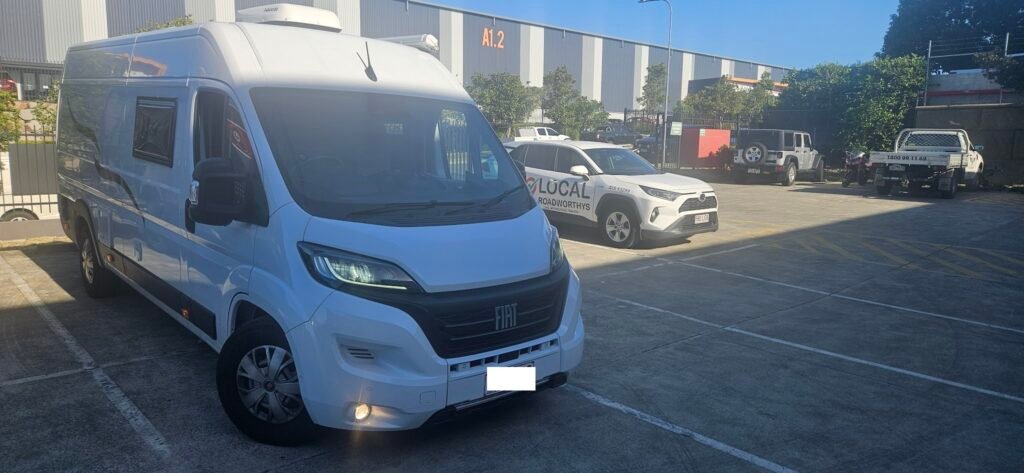
I inspected this Fiat Ducato motorhome at a dealership in Stapylton today. Passed without any issues. But even the dealer had a question – how long is the roadworthy valid for? The answer is 2 months or 2,000km for a private sale, whichever comes first. For a licensed dealer, it’s 3 months or 1,000km.
Motorhomes are becoming more popular every year and I’m inspecting more of them. Here’s what motorhome owners need to know about roadworthys in Queensland.
The roadworthy inspection is the same as a car
A motorhome roadworthy is the same inspection as any other light vehicle. I check tyres, brakes, suspension, steering, lights, windscreen, mirrors, seat belts, underbody, warning lights, horn, wipers, and everything else on the standard checklist. The test drive and recorded brake test are included.
The fact that there’s a kitchen, a bed, and a bathroom behind the driver’s seat doesn’t change what gets inspected. A roadworthy is a safety inspection of the vehicle – not the living quarters.
I don’t inspect gas appliances, water systems, electrical systems inside the living area, fridges, stoves, or any of the camper fitout. That’s not part of a roadworthy.
Gas appliances need a separate gas certificate
This is the important part that catches a lot of motorhome owners off guard.
If your motorhome has gas appliances – a gas cooktop, a gas hot water system, a gas heater, or any other LPG-powered appliance – you need a gas compliance certificate on top of the roadworthy for registration or registration transfer in Queensland.
A gas certificate is a separate inspection done by a licensed gas fitter, usually a plumber with gas qualifications. It confirms that the gas system, lines, connections, and appliances are safe and comply with Australian standards.
I do not do gas inspections. This is a plumber’s job, not a mechanic’s job. You need to arrange the gas certificate separately from your roadworthy.
Make sure you have both before going to TMR
If your motorhome has gas appliances and you show up at TMR with only a roadworthy, you’ll be turned away. You need both certificates to complete a registration or registration transfer.
Get the roadworthy and the gas certificate sorted before you go to TMR. The order doesn’t matter – you can get the gas certificate first or the roadworthy first. Just make sure you have both in hand before making the trip.
If your motorhome doesn’t have any gas appliances – for example, an all-electric setup – then you only need the roadworthy. No gas certificate required.
Common motorhome issues I see
Motorhomes share the same fail points as any car or van, with a few extras:
Tyres. Motorhomes are heavy and many spend long periods parked between trips. Tyres deteriorate from age and UV exposure even if the tread looks fine. Cracked sidewalls from sitting in the sun for months are a common fail. Check the date code on the tyre sidewall – tyres older than 7-10 years should be replaced regardless of tread depth.
Lights. Motorhomes are larger than cars and sometimes have additional clearance lights or marker lights. Every light must work.
Weight. Motorhomes are heavy vehicles. Make sure your motorhome is under 4,500kg GVM (Gross Vehicle Mass) for a standard roadworthy inspection. If it’s over 4,500kg GVM, it falls into the heavy vehicle category and requires a different type of inspection (Certificate of Inspection) which has different rules. I inspect light vehicles up to 4,500kg GVM only.
Suspension. The extra weight of the camper conversion puts more stress on the suspension than a standard van. Leaking shocks and worn bushes are more common on motorhomes than on equivalent vans used for commercial purposes.
Seat belts. Every seating position must have a working seat belt. If seats have been added or moved as part of the camper conversion, the seat belts must be fitted and functional. If the seating capacity has been changed, a modification plate may be required.
Secure everything inside before the inspection
I need to take your motorhome for a test drive and a recorded brake test. During the brake test, I brake firmly. Anything that isn’t secured inside the living area will fly forward – pots, pans, bottles, loose items on benches, anything in cupboards without latches.
I’ve had motorhomes where the entire kitchen empties itself onto the floor during the brake test. Plates smashing, tins rolling, drawers flying open. It’s not a great experience for anyone.
Before I arrive, pack everything away securely. Close all cupboards and make sure the latches hold. Remove anything loose from benchtops. If you have items stored on shelves without restraints, take them down. Treat it like you’re about to drive on a rough dirt road – because a firm brake test has the same effect on unsecured items.
Buying a used motorhome?
A roadworthy tells you the vehicle is safe to drive. A gas certificate tells you the gas system is safe. Neither one tells you about the overall condition of the motorhome – the engine health, transmission, water leaks in the living area, the condition of the camper fitout, or whether the conversion was done properly.
If you’re spending serious money on a used motorhome, consider a pre-purchase inspection for the vehicle side plus a gas inspection for the gas side. That combination gives you the fullest picture before you commit.
Related: camper trailer roadworthy rules, buying a backpacker campervan and seating changes and LK1 mod plates. See prices.