Cracked Control Arm Bushes Failed Roadworthy - Mazda 3 in Alexandra Hills

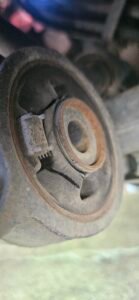
I inspected a Mazda 3 in Alexandra Hills today. It failed for cracked front lower control arm bushes. This is a fairly common fail point, especially on older vehicles, and most owners have no idea what a control arm bush even is until it shows up on their inspection report.

What do control arms and bushes actually do?

The lower control arms are part of your car’s front suspension. They connect the front wheels to the chassis of the car and allow the wheels to move up and down over bumps while keeping them in the correct alignment. Every time you drive over a pothole, speed bump, or uneven road, the control arms are absorbing that movement.

The bushes are the rubber components that sit at the mounting points of the control arm where it bolts to the chassis. They act as a cushion between the metal arm and the metal frame. Their job is to absorb vibration, reduce noise, and allow the control arm to pivot smoothly. Think of them as the joint between the arm and the body of the car.

Over time, the rubber in these bushes deteriorates. Heat, road grime, age, and constant movement all take their toll. The rubber dries out, cracks, and eventually breaks apart. That’s exactly what happened on this Mazda 3 – the rubber was visibly cracked and separating.

Why cracked control arm bushes fail a roadworthy

Cracked or perished bushes are a fail because once the rubber is gone, the control arm has excessive play. Instead of being held firmly in position, it can move around more than it should. This affects the car in several ways:

Steering becomes vague and imprecise. You might notice the car doesn’t respond as sharply when you turn the wheel, or it wanders slightly on the highway.

Wheel alignment goes out. When the control arm can shift position, the front wheels are no longer sitting at the correct angle. This causes uneven tyre wear and can make the car pull to one side.

Clunking or knocking noises appear, especially when going over bumps, turning, or braking. If you hear a knock from the front end when you hit a pothole, worn bushes are one of the most common causes.

In extreme cases, a completely failed bush can allow the control arm to move so far out of position that it affects braking stability and cornering grip. At highway speed, this is genuinely dangerous.

How to spot this yourself

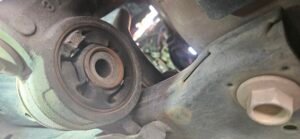
You can check your own control arm bushes without any tools. Turn the steering wheel to full lock in one direction. Then look under the car behind the front wheel on the opposite side – you’re looking through the gap between the tyre and the wheel arch. You should be able to see the rubber bushes where the control arm connects to the chassis.

If the rubber looks cracked, split, perished, or is bulging out of its housing, it needs replacing before the car can pass a roadworthy. If you’re not sure what you’re looking at, that’s fine – it’s one of the many things I check during the inspection. But if you spot obvious cracks, get them replaced beforehand and save yourself a re-inspection fee.

Replacing control arm bushes is a standard job for any mechanic and is usually not too expensive depending on the vehicle.

Ready to book your mobile roadworthy? I come to your home or work in South Brisbane, Redlands and Logan. Starting from $110.

Lets get my roadworthy sorted.

Free Roadworthy Preparation Guide and Checklist

Roadworthy Checklist: Get Your Vehicle Passed the First Time

Don’t risk failing your inspection for something simple. This checklist reveals the most common fail points and gives you easy-to-follow steps to make sure your car, motorcycle, or trailer is ready for inspection. + Bonus: How to sell your vehicle for a good price quick.

Free [x]

Lead Magnet Title Goes Here

Lorem ipsum dolor sit amet, consectetur adipiscing elit. Ut elit tellus, luctus nec ullamcorper mattis, pulvinar dapibus leo.