How to Transfer Car, Motorcycle or Trailer Registration in Queensland
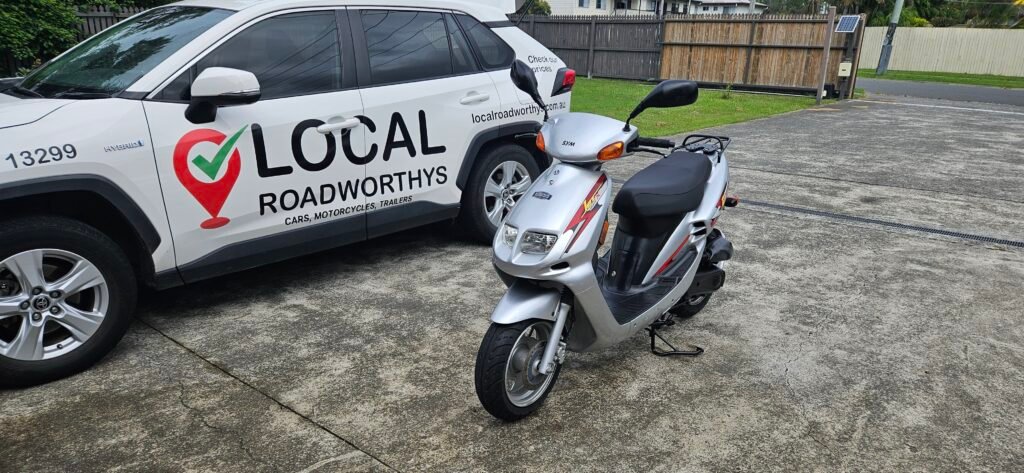
I inspected this SYM moped scooter in Loganholme today and walked the seller through the transfer process after the inspection. It’s something I explain to customers regularly, so here’s the full rundown on how to transfer vehicle registration in Queensland.
Step 1 - Get a roadworthy certificate
Before any transfer can happen, the seller needs a valid safety certificate (roadworthy certificate). Without it, the registration cannot be transferred to the buyer. This applies to cars, motorcycles and trailers.
After a passed inspection with Local Roadworthys, you’ll receive an electronic safety certificate by email straight away – while I’m still on site. The email comes directly from Queensland Transport and Main Roads, from a .gov.au email address. This confirms the certificate is legitimate and registered in the government system.
If you ever receive a safety certificate that doesn’t come from a .gov.au email address, question it. A legitimate certificate is always issued through the government portal. If the inspector can’t send it through the official system, you should be concerned about whether the certificate is real.
Step 2 - Transfer online (easiest method)
The email from TMR includes a link for online registration transfer. This is by far the easiest and fastest way to do it.
Both the seller and the buyer need a Queensland TMR customer reference number (CRN). Your QLD driver’s licence number is your CRN. If you have a QLD licence, you already have a CRN.
The online transfer is instant. The moment it’s completed, the vehicle is registered in the buyer’s name. If the buyer gets a toll or a fine on the drive home, it’s in their name – not yours. That’s peace of mind.
If the buyer doesn’t have a CRN – for example, if they’ve just moved to Queensland or have never registered a vehicle here before – an online transfer isn’t possible. You’ll need to use the paper form instead.
Step 3 (alternative) - Transfer using the paper form
If an online transfer isn’t an option, you can use the Vehicle Registration Transfer Application form (F3520_CFD). This form has a seller’s copy and a buyer’s copy.
Fill out both copies together. On the form there’s a section for the safety certificate – enter the certificate number and the date it was issued. The certificate number is in the top right corner of the safety certificate. It starts with LV- for cars, MC- for motorcycles, or LT- for trailers.
The seller keeps the seller’s copy. The buyer takes the buyer’s copy to a TMR customer service centre to complete the transfer and pay the transfer fee.
My honest advice - make sure the transfer is completed before you walk away
This is where I speak from personal experience.
I sold a motorcycle to a buyer who didn’t have a CRN because he had recently moved to Australia. We couldn’t do the online transfer, so we filled out the paper form. I handed over the bike and the paperwork, and the buyer left.
A few weeks later, toll bills started arriving at my address. Then a fine for running a red light – on that motorcycle. I tried to contact the buyer. He never answered the phone.
It was a massive hassle to prove that I had sold the motorcycle and to avoid paying those tolls and the red light fine. I had the seller’s copy of the form, but tracking down the buyer and resolving it with TMR and the toll company took weeks of phone calls and paperwork.
That experience taught me a lesson I’ll never forget. Now my advice to every seller is this:
If you can do the online transfer – do it. It’s instant, it’s confirmed, and the vehicle is out of your name immediately.
If you can’t do the online transfer – go to a TMR customer service centre together with the buyer and complete the transfer on the spot. Don’t let the buyer drive away with the vehicle still in your name and a promise to “sort it out later.” It’s not worth the risk.
Verify the buyer’s identity when filling out the transfer form. Make sure the name, address, and licence details are correct. If something goes wrong later, you need to be able to prove who you sold it to.
Taking these extra steps might feel overly cautious, but when fines and toll bills start arriving in your letterbox for a vehicle you no longer own, you’ll be glad you did.